
Best Transportation for Corporate Events: Planning Guide
By Hassan Tariq ·
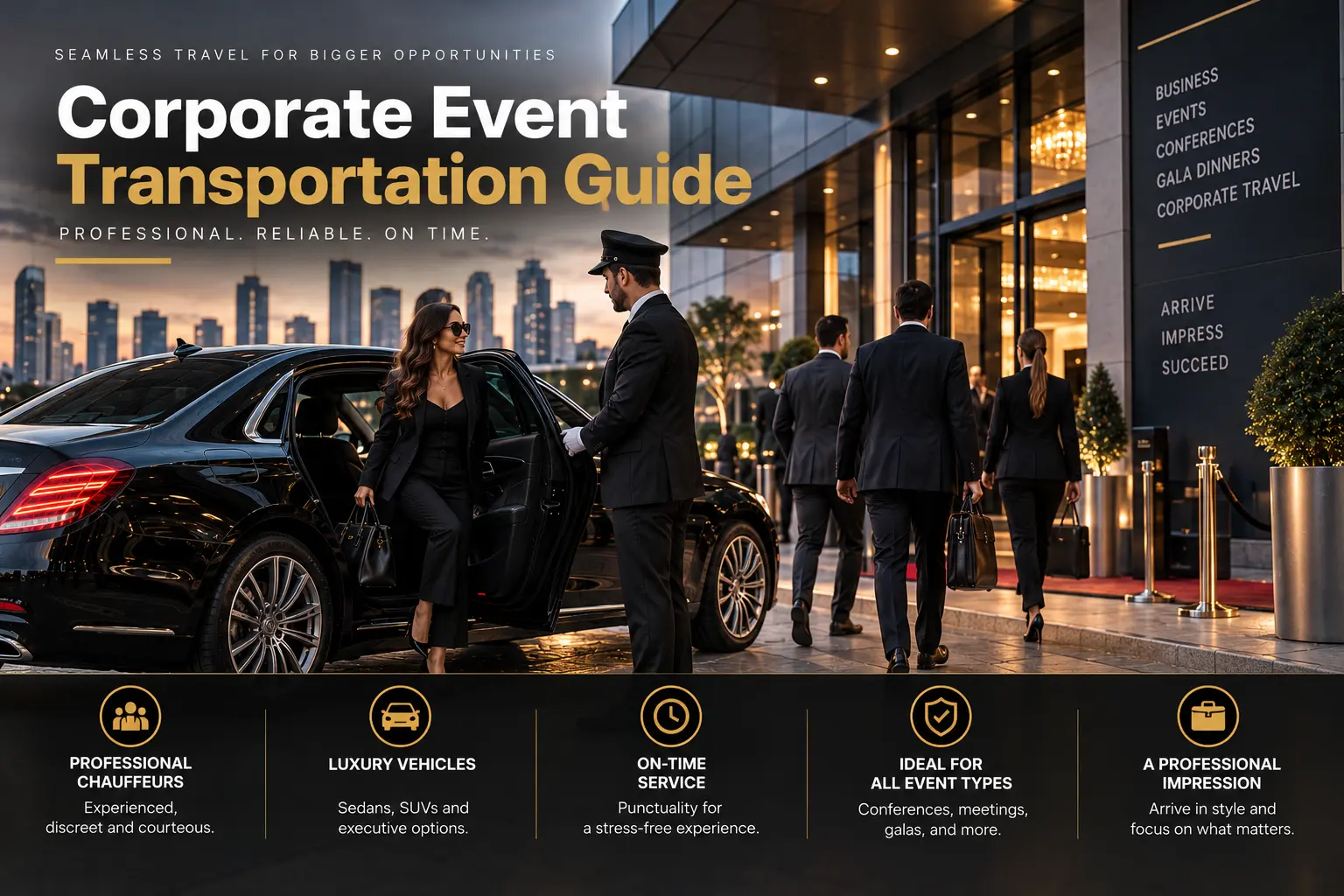
Whether you're organizing a conference, executive meeting, company retreat, trade show, client dinner, product launch, or multi-day business event, attendees need to move between airports, hotels, offices, venues, restaurants, and other locations efficiently.
Choosing the best transportation for corporate events therefore requires more than simply booking enough vehicles.
You need to consider guest count, executive requirements, airport arrivals, luggage, vehicle capacity, pickup schedules, multiple venues, traffic, communication, and contingency planning.
For many business events, professionally coordinated corporate transportation provides the flexibility to manage these moving parts while giving executives, clients, employees, and guests a more organized travel experience.
This guide explains how to build a corporate event transportation plan from the first airport arrival to the final departure.
What Is the Best Transportation for Corporate Events?
There isn't one vehicle or transportation method that's best for every corporate event.
The right solution depends on:
Number of attendees
Executive and VIP requirements
Airport arrivals
Hotel locations
Event venue
Number of daily transfers
Group sizes
Luggage
Event schedule
Transportation budget
Desired service level
A small executive dinner may require only a few luxury sedans or SUVs.
A large conference could require executive vehicles, vans, Sprinter-style vehicles, and coordinated airport transfers.
Professional corporate transportation allows transportation to be planned around the event rather than treating every transfer as a separate last-minute ride.
The key is to match the transportation structure to the event.
1. Start With the Complete Event Schedule
Before choosing vehicles, build the transportation plan around your event schedule.
Create a timeline showing:
Guest arrival dates
Flight arrival times
Hotel check-ins
Event start times
Meeting schedules
Lunches and dinners
Off-site activities
Conference sessions
Networking events
Event end times
Return flights
Transportation should then be mapped against this schedule.
For example:
8:00 AM — Hotel → Conference Venue
12:30 PM — Conference Venue → Client Lunch
2:00 PM — Client Lunch → Office
6:30 PM — Office → Corporate Dinner
9:30 PM — Corporate Dinner → Hotel
This approach helps identify how many vehicles you actually need and when you need them.
2. Determine Your Guest Count
Guest count is one of the most important corporate transportation planning factors.
But don't simply ask:
“How many people are attending?”
You also need to determine how many people need transportation at the same time.
Imagine a conference with 100 attendees.
If 70 attendees arrange their own transportation and only 30 require company-provided transportation, your requirements are very different.
Likewise, those 30 guests may not all travel together.
Some could be:
Arriving at different airports
Staying at different hotels
Attending different meetings
Departing at different times
Break attendees into transportation groups before selecting vehicles.
3. Plan Airport Arrivals Carefully
Airport transportation is often the first major challenge of a corporate event.
Guests may arrive:
On different airlines
At different terminals
At different times
At different airports
With different amounts of luggage
Trying to manage these details on event day can quickly become complicated.
Create an airport arrival manifest containing:
Passenger name
Mobile number
Airline
Flight number
Arrival airport
Scheduled arrival time
Hotel or destination
Number of passengers
Luggage requirements
Transportation assignment
Professional airport transportation can then be coordinated around those arrival details.
Group Guests When Practical
If several employees arrive at approximately the same time and are traveling to the same hotel, group transportation may be more efficient than arranging separate vehicles for every passenger.
However, avoid making an executive or client wait an unreasonable amount of time simply to combine transfers.
Balance efficiency with passenger experience.
4. Identify Executives and VIP Guests
Not every attendee necessarily requires the same transportation experience.
Executives, board members, investors, keynote speakers, major clients, and VIP guests may need individual transportation.
These passengers may have:
Tight schedules
Confidential calls
Multiple meetings
Separate hotel arrangements
Different arrival times
Additional security or privacy considerations
A private chauffeur-driven sedan or SUV can be appropriate for these journeys.
Professional chauffeur transportation allows the vehicle to become a private travel environment where passengers can:
Make calls
Review documents
Answer emails
Prepare for meetings
Relax between appointments
If executive transportation is an important part of your event, understanding what a professional chauffeur does can help you determine the level of service required.
5. Choose Vehicles Based on the Actual Requirement
Corporate event transportation doesn't mean using the same vehicle for every passenger.
Different parts of the event may require different vehicle categories.
Luxury Sedans
Suitable for:
Individual executives
VIP guests
Clients
Airport transfers
Business meetings
Premium SUVs
Useful for:
Small executive groups
Passengers with additional luggage
Airport transfers
VIP transportation
Executive Vans or Sprinters
Useful for:
Corporate teams
Conference groups
Airport arrivals
Hotel-to-venue transportation
Event transfers
Review the RideBlackX fleet when planning vehicle requirements for different parts of your corporate event.
Don't Forget Luggage
A vehicle capable of seating several passengers may not necessarily accommodate all of their luggage.
Airport transportation should therefore consider:
Passenger capacity + luggage capacity.
6. Decide Between Individual and Group Transportation
Corporate events often need a combination of both.
Individual Transportation
Best suited to:
CEOs
Executives
Investors
Keynote speakers
Important clients
VIP guests
Group Transportation
Better suited to:
Employees
Conference attendees
Teams
Guests staying at the same hotel
Attendees traveling to the same venue
Using both strategically can provide professional service without unnecessarily assigning individual vehicles to every attendee.
7. Coordinate Hotel-to-Venue Transportation
One of the most repetitive transportation requirements during corporate events is moving guests between hotels and venues.
If many attendees are staying at the same hotel, establish clear departure times.
For example:
Morning Transfer
Hotel lobby meeting time: 7:45 AM
Vehicle departure: 8:00 AM
Event begins: 9:00 AM
Clear scheduling reduces confusion.
Communicate:
Meeting point
Departure time
Vehicle information where appropriate
Destination
Event contact
Instructions for late passengers
Avoid vague instructions such as:
“Transportation will be outside around 8.”
Corporate transportation works best when passengers know exactly what they're expected to do.
8. Build Buffer Time Into the Schedule
One of the biggest corporate transportation mistakes is creating a schedule with no margin for delay.
Road travel can be affected by:
Traffic
Construction
Accidents
Weather
Event congestion
Security procedures
Passenger delays
If a meeting begins at 10:00 AM, don't create a transportation schedule that expects the vehicle to arrive at exactly 9:59 AM.
Build a reasonable buffer into important transfers.
This is particularly important for:
Airport departures
Keynote presentations
Client meetings
Executive appointments
Ticketed events
A little additional planning time is generally better than creating an unnecessarily rushed experience.
9. Account for Traffic Around Major Events
Large conferences, sporting events, concerts, trade shows, and conventions can dramatically affect local traffic.
If your corporate event overlaps with another major event, normal travel times may not apply.
Before finalizing transportation schedules, consider:
Venue traffic
Road closures
Parking restrictions
Hotel congestion
Airport traffic
Local events
Professional transportation planning should account for these conditions where reasonably possible.
For especially important transfers, schedule additional travel time.
10. Create a Clear Communication Plan
Transportation problems become much easier to solve when everyone knows who to contact.
Your corporate transportation plan should define communication between:
Event organizer
Transportation provider
Chauffeurs
Hotel staff where relevant
Guests
Executive assistants
Event coordinators
Guests should know:
Their pickup time
Pickup location
Destination
Who to contact if plans change
Event organizers should have an updated transportation manifest available.
For larger events, avoid relying on scattered emails and text messages as the only record of transportation assignments.
Maintain one centralized schedule.
11. Plan for Schedule Changes
Corporate events rarely run exactly according to plan.
A meeting can finish early.
A conference session can run late.
An executive may add another appointment.
A client's flight may change.
A dinner location might move.
Your transportation plan should therefore have some flexibility.
When possible, identify in advance:
Which rides are fixed
Which transportation can be adjusted
Who is authorized to make changes
How changes will be communicated
Whether additional vehicle time may be required
This becomes particularly important for executives with evolving schedules.
An hourly chauffeur arrangement may be more practical than repeatedly arranging individual transfers when the itinerary is likely to change.
12. Consider Hourly Chauffeur Service
Point-to-point transportation works well when the itinerary is simple:
Airport → Hotel
But an executive itinerary may look like:
Hotel → Meeting → Lunch → Client Office → Conference → Dinner → Hotel
In this situation, hiring a chauffeur for a defined period may simplify transportation.
Hourly chauffeur service can be useful when:
There are multiple stops
Meeting times may change
A vehicle needs to remain available
An executive has a full-day schedule
Clients are being entertained
Transportation needs to remain flexible
Our guide on private chauffeur cost explains the pricing factors that can affect hourly and private chauffeur transportation.
13. Plan Corporate Dinner Transportation
Corporate dinners create their own transportation requirements.
Guests may travel from:
Conference venue
Office
Hotel
Separate meetings
and usually need transportation back afterward.
Consider:
Number of guests
Restaurant reservation time
Grouping passengers
Return schedule
Vehicle capacity
Multiple hotels
If alcohol is being served, professionally arranged transportation can also reduce the need for guests to personally drive between the dinner and hotel.
Plan both the outbound and return journey rather than focusing only on getting everyone to the restaurant.
14. Prepare for Multiple Airports
Some cities and regions are served by several airports.
Corporate guests may therefore arrive at different locations.
This creates additional complexity because:
Travel distances vary
Traffic conditions differ
Pickup procedures vary
Arrival times may overlap
Vehicle assignments become more complicated
Your arrival manifest should clearly identify each passenger's airport.
Never assume every attendee is using the same airport.
15. Coordinate Departure Transportation
Event organizers often plan arrivals carefully but treat departures as an afterthought.
Don't make that mistake.
Before the event ends, collect:
Departure airport
Airline
Flight number
Flight time
Hotel
Passenger count
Luggage requirements
Then calculate transportation schedules based on when passengers need to arrive at the airport.
Our guide explaining how early to book an airport car service can help with advance transportation planning.
Remember that the vehicle pickup time and the required airport arrival time are two different things.
Travel time needs to be included between them.
16. Create a Transportation Contingency Plan
Even well-planned events can experience unexpected changes.
Consider what happens if:
A flight is delayed
A flight is canceled
A meeting runs late
A guest changes hotels
A vehicle requirement changes
Traffic becomes significantly worse
An attendee misses a scheduled departure
Another guest unexpectedly requires transportation
You don't need a separate vehicle sitting unused for every possible problem.
But you should know how transportation changes will be handled.
Identify:
Primary transportation contact
Event decision-maker
Communication procedure
Process for requesting additional transportation
Preparation makes unexpected situations easier to manage.
17. Understand Corporate Transportation Pricing
Corporate event transportation costs depend on the structure of the event.
Pricing may be influenced by:
Vehicle category
Number of vehicles
Duration
Distance
Number of transfers
Waiting time
Airport requirements
Parking
Tolls
Event location
Additional stops
Chauffeur hours
Don't compare transportation providers based only on one hourly or transfer rate.
Instead, request pricing around the actual event schedule.
For example:
3 airport transfers + 2 executive vehicles + 1 group vehicle + evening event transportation
provides a much more useful basis for a quote than simply asking:
“How much is a car?”
Corporate Event Transportation Planning Checklist
Before finalizing transportation, make sure you've covered the following:
Attendees
Total guest count
Number requiring transportation
VIP and executive list
Passenger contact information
Flights
Arrival airports
Airlines
Flight numbers
Arrival times
Departure flights
Hotels
Guest hotel locations
Hotel pickup points
Departure schedules
Vehicles
Sedan requirements
SUV requirements
Group vehicle requirements
Passenger capacity
Luggage capacity
Schedule
Event start times
Meeting times
Dinners
Off-site activities
Return transportation
Communication
Event transportation contact
Guest instructions
Change-management process
Contingency
Flight delays
Schedule changes
Additional passengers
Unexpected transportation requests
A centralized checklist can prevent small transportation details from becoming large event-day problems.
Common Corporate Transportation Mistakes
Several planning mistakes occur repeatedly.
Booking Too Late
Waiting can reduce availability, especially when several vehicles are required.
Ignoring Luggage
Airport groups need enough room for both passengers and bags.
Using One Vehicle Type for Everyone
Executives and large groups may have completely different requirements.
Scheduling Without Traffic Buffers
An itinerary that works only under perfect traffic conditions is too fragile.
Failing to Plan Return Transportation
Getting guests to an event is only half the job.
No Central Transportation Contact
Guests need to know who to contact if something changes.
Treating Every Transfer Separately
For complex executive schedules, hourly transportation may be more efficient.
Why Professional Transportation Matters for Corporate Events
Transportation is part of the event experience.
Imagine inviting an important client to a conference.
Their experience might begin:
Airport → Vehicle → Hotel → Event
If transportation is confusing or poorly coordinated, that becomes part of their impression of the event.
Professionally arranged transportation can help create a more organized experience through:
Advance scheduling
Appropriate vehicles
Professional chauffeurs
Clear communication
Executive transportation
Group coordination
Airport planning
This doesn't mean every attendee requires a luxury sedan.
It means transportation should reflect the needs of each passenger group.
Frequently Asked Questions
What is the best transportation for corporate events?
The best transportation depends on guest count, schedule, vehicle requirements, airport arrivals, executives, luggage, and event locations. Many corporate events benefit from combining executive sedans or SUVs with larger group vehicles.
How far ahead should corporate event transportation be booked?
Book as early as possible once your event date, guest count, and transportation requirements become clear. Events requiring several vehicles, group transportation, airport pickups, or specific vehicle categories generally benefit from earlier reservations.
What vehicles are best for corporate events?
Luxury sedans can work well for executives and individual guests, SUVs for small groups and additional luggage, and executive vans or Sprinter-style vehicles for larger groups. The right choice depends on passenger and luggage requirements.
Should corporate events provide airport transportation?
It can be particularly valuable for executives, clients, speakers, international visitors, and organized groups. Airport transportation should be planned around flight information, luggage, arrival times, and pickup procedures.
Is hourly chauffeur service useful for corporate events?
Yes, particularly for executives with several meetings or changing schedules. Hourly transportation can allow the chauffeur and vehicle to remain available during the reserved period.
How do you organize transportation for a large corporate event?
Start with a centralized transportation manifest containing guest information, flight details, hotels, pickup times, destinations, vehicle assignments, and contact information. Group passengers where practical and create contingency procedures for changes.
Plan Your Corporate Event Transportation With RideBlackX
Choosing the best transportation for corporate events isn't simply about reserving vehicles.
It's about building transportation around the event.
That means understanding:
Who needs transportation?
When do they arrive?
Where are they staying?
Which guests require executive service?
How much luggage are they carrying?
Which vehicles are appropriate?
What happens if the schedule changes?
A well-planned transportation strategy helps executives, employees, clients, and guests move between airports, hotels, meetings, venues, and events with fewer logistical complications.
RideBlackX provides professional transportation for executive travel, airport transfers, corporate meetings, conferences, events, and group itineraries.
Explore RideBlackX corporate transportation and plan transportation around the needs of your next business event.