
Contents
- What Is Flight Tracking for Airport Transportation?
- Why Scheduled Arrival Time Alone Isn't Enough
- 1. Flight Tracking Helps Identify Delays
- 2. It Can Help With Early Arrivals
- 3. It Helps Chauffeur Coordination
- 4. It Can Reduce Unnecessary Waiting
- 5. Flight Tracking Supports Meet-and-Greet Service
- 6. It Helps With International Airport Transfers
- 7. It Can Improve Business Travel Coordination
- 8. It Helps When Transportation Is Booked for Someone Else
- 9. Flight Tracking Helps With Corporate Guest Arrivals
- 10. It Helps Coordinate Group Arrivals
- 11. It Can Improve Communication
- What Flight Tracking Cannot Tell the Transportation Provider
- Landing Time vs Gate Arrival vs Passenger Pickup
- Landing Time
- Gate Arrival
- Passenger Pickup Time
- What Happens if Your Flight Is Delayed?
- What Happens if Your Flight Is Canceled?
- What Happens if You Miss a Connection?
- Why the Correct Flight Number Matters
- Should You Still Tell the Chauffeur About a Delay?
- Does Flight Tracking Mean the Chauffeur Waits Indefinitely?
- Is Flight Tracking Useful for Departures?
- How Early Should You Book an Airport Transfer?
- Flight Tracking vs On-Demand Airport Transportation
- Who Benefits Most From Flight-Coordinated Airport Transportation?
- Business Travelers
- Executives
- International Travelers
- Corporate Clients
- Families
- Groups
- First-Time Visitors
- Information to Provide When Booking Airport Transportation
- Flight Details
- Passenger Details
- Luggage
- Ground Transportation
- Airport Transfer Checklist for Flight Changes
- 1. Is My Flight Number Still the Same?
- 2. Has My Arrival Airport Changed?
- 3. Has My Arrival Date Changed?
- 4. Does My Pickup Reservation Need Updating?
- 5. Do I Still Have the Correct Pickup Instructions?
- Frequently Asked Questions
- How does flight tracking improve airport transfers?
- Can a chauffeur see if my flight is delayed?
- Will airport car service automatically adjust for a delayed flight?
- Should I provide my flight number when booking airport transportation?
- Does flight tracking tell the chauffeur when I leave baggage claim?
- What if the airline changes my flight?
- Does flight tracking eliminate waiting charges?
- Is flight tracking useful for international airport pickups?
- Make Airport Transfers Easier With Better Coordination
A flight may land early. It may be delayed by weather, air traffic, mechanical issues, or operational changes. Even after landing, passengers may spend additional time taxiing to the gate, collecting luggage, clearing immigration, or passing through customs.
That is why flight information can play an important role in professionally arranged airport transportation.
But how does flight tracking improve airport transfers?
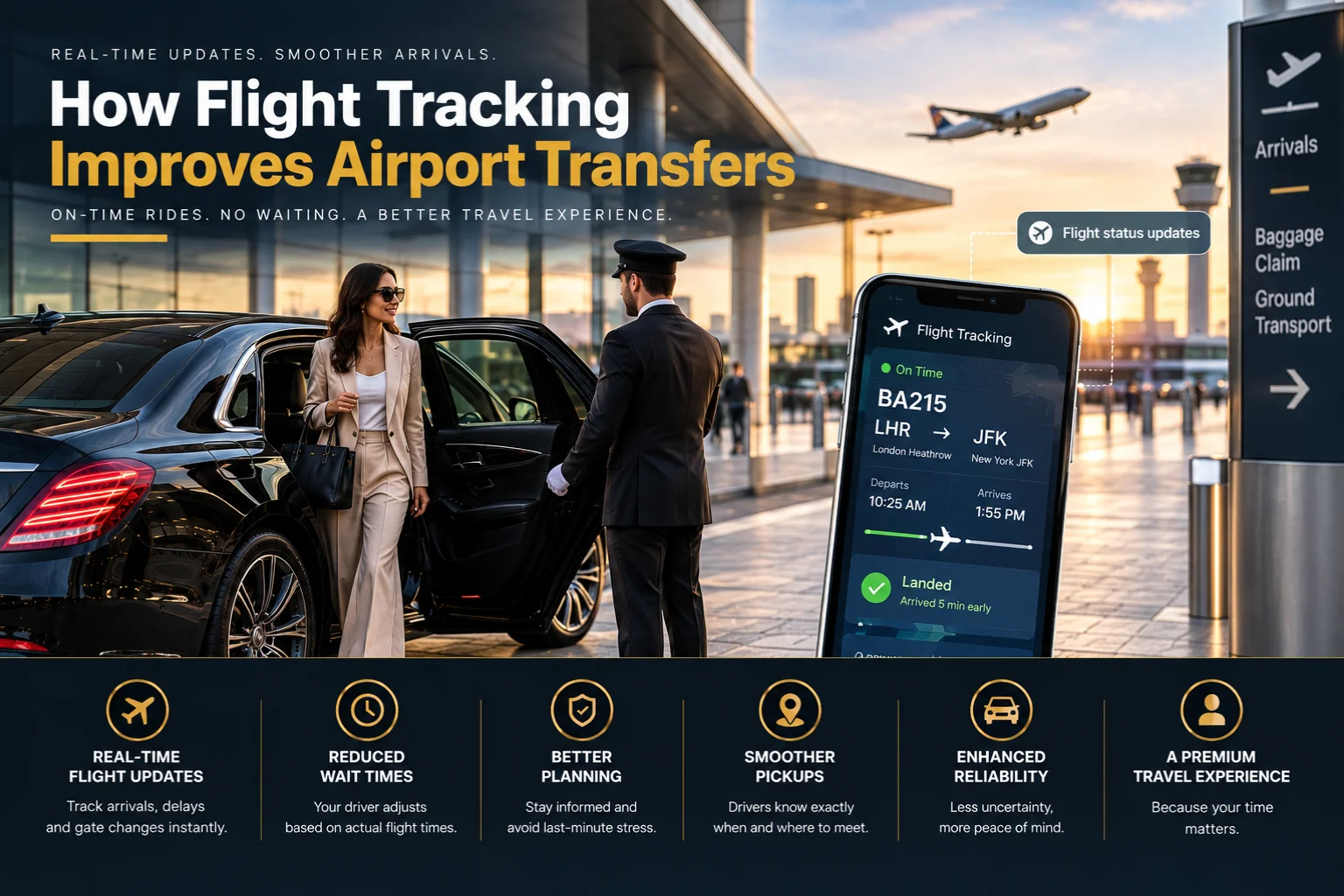
Flight tracking gives transportation providers useful arrival information that can help them coordinate pickups around the passenger's actual flight rather than relying only on the original scheduled arrival time. When combined with accurate booking details and passenger communication, it can reduce unnecessary waiting, improve chauffeur coordination, and create a smoother airport pickup.
It does not eliminate every airport delay or automatically reveal when a passenger will exit the terminal, but it provides valuable information for planning.
Here's how it works.
What Is Flight Tracking for Airport Transportation?
Flight tracking means monitoring available flight information connected to a passenger's reservation.
When booking an airport transfer service, passengers may provide information such as:
Airline
Flight number
Arrival airport
Arrival date
Scheduled arrival time
The transportation provider can use those details to follow relevant flight-status information when coordinating the pickup.
That information may indicate that the flight is:
Scheduled
Delayed
Arriving early
In the air
Landed
Canceled
The exact information available depends on the flight and tracking source.
The important point is that the transportation provider has more information than simply:
“The passenger said they would arrive at 5:00 PM.”
Why Scheduled Arrival Time Alone Isn't Enough
Imagine a passenger books transportation for a flight scheduled to arrive at 6:30 PM.
But the flight is delayed and actually lands at 8:00 PM.
If transportation planning relies only on the original schedule, the chauffeur could arrive far too early.
Now imagine the opposite.
The flight is scheduled for 6:30 PM but lands at 6:00 PM.
The passenger may reach the terminal earlier than expected.
Flight information gives the transportation provider additional context when coordinating the pickup.
This is particularly valuable for airport transfers because flight schedules can change even after the passenger has started traveling.
1. Flight Tracking Helps Identify Delays
Delays are one of the most obvious reasons flight tracking matters.
Flights can be delayed because of:
Weather
Air traffic
Aircraft availability
Operational issues
Airport congestion
Earlier flight disruptions
If relevant flight information indicates a delay, the transportation provider has better information for planning the pickup.
Without that information, transportation could remain tied to an outdated scheduled arrival time.
For passengers, this can make professionally arranged airport transportation easier to coordinate.
2. It Can Help With Early Arrivals
Not every schedule change is a delay.
Flights can arrive early.
If a passenger's flight is ahead of schedule, relevant arrival information can help the transportation provider understand that the passenger may reach the pickup process earlier than originally expected.
However, an early landing does not necessarily mean the passenger will immediately be ready.
They may still need to:
Reach the gate
Leave the aircraft
Walk through the terminal
Collect luggage
Clear immigration or customs
Flight tracking improves awareness, but it doesn't replace realistic airport timing.
3. It Helps Chauffeur Coordination
Professional airport transportation requires coordination between several pieces of information:
Flight → Passenger → Airport → Pickup instructions → Chauffeur → Vehicle
Flight status can help the transportation provider determine when the arrival process is actually beginning.
This can support better chauffeur coordination, particularly when the reservation involves:
Busy airports
International flights
Late-night arrivals
Early-morning arrivals
Business travelers
Meet-and-greet service
The chauffeur still needs to follow the airport's commercial pickup rules and the provider's procedures.
Flight tracking simply provides another useful source of trip information.
4. It Can Reduce Unnecessary Waiting
Suppose a flight is delayed by two hours.
Without updated flight information, transportation may be positioned based on the original arrival schedule.
That can create unnecessary waiting.
Flight tracking can help transportation providers respond more appropriately to known delays.
This matters because waiting can affect:
Chauffeur time
Vehicle availability
Airport parking
Scheduling
Transportation costs
The exact waiting policy still depends on the provider and reservation.
Our guide to airport car service cost explains how waiting time, parking, airport charges, vehicle type, and other factors can affect pricing.
5. Flight Tracking Supports Meet-and-Greet Service
Flight information becomes especially useful when meet-and-greet transportation is arranged.
With meet and greet, the passenger may need to meet the chauffeur or representative at an agreed location after completing airport arrival procedures.
Flight status helps establish when the passenger's arrival process begins.
However, it cannot tell the chauffeur exactly when the passenger will complete:
Immigration
Baggage claim
Customs
Terminal navigation
That is why flight tracking and passenger communication work best together.
Our guide on how airport meet and greet service works explains the full process from booking and flight details to meeting the chauffeur and reaching the vehicle.
6. It Helps With International Airport Transfers
International arrivals can be particularly difficult to predict.
After landing, travelers may need to complete:
Taxiing to the gate
Deplaning
Walking to immigration
Passport control
Baggage collection
Customs
Terminal exit
This process can vary considerably between passengers and flights.
Flight tracking provides information about the aircraft.
Passenger communication provides information about the traveler.
Both can be important.
For example:
Flight tracking: Aircraft landed at 7:12 PM.
Passenger communication: Passenger has collected luggage and is proceeding through customs.
Together, those pieces of information provide a clearer picture than either one alone.
7. It Can Improve Business Travel Coordination
Business travelers often have schedules that begin immediately after arrival.
A typical itinerary might be:
Airport → Hotel → Office → Client Meeting
A significant flight delay can affect every stage.
If the transportation provider has relevant flight information, the airport transfer can be coordinated around the changed arrival.
The travel coordinator or executive assistant can also update later parts of the itinerary where necessary.
Professional corporate transportation becomes particularly useful when airport transportation is connected to meetings, hotels, events, and executive schedules.
8. It Helps When Transportation Is Booked for Someone Else
Many airport reservations are not made by the passenger.
Transportation may be arranged by:
Executive assistant
Employer
Travel manager
Event organizer
Hotel
Family member
In those cases, the person booking the transportation may not be traveling with the passenger.
Accurate flight details become even more important.
Instead of relying on the organizer to continuously update the transportation provider about routine flight timing changes, flight-status information can help with coordination.
The passenger should still have relevant pickup instructions and contact details.
9. Flight Tracking Helps With Corporate Guest Arrivals
Imagine your company is hosting an executive arriving from another city.
Their flight is scheduled for 3:15 PM.
The plan is:
Airport → Hotel → Corporate Dinner
If the flight is delayed significantly, the dinner schedule may need adjustment.
Airport transportation connected to accurate flight information can help reduce uncertainty around the arrival.
This can be particularly useful when transporting:
Clients
Investors
Senior executives
Speakers
Business partners
Our guide on how to arrange executive transportation covers flight information, vehicles, schedules, hotels, meetings, and multi-stop transportation in greater detail.
10. It Helps Coordinate Group Arrivals
Group airport transportation can involve several flights.
For example:
Group A: Flight arrives at 1:10 PM
Group B: Flight arrives at 2:05 PM
Group C: Flight arrives at 4:20 PM
If one flight becomes significantly delayed, the transportation plan may need to change.
Depending on the situation, the provider might need to coordinate:
Different pickup groups
Multiple vehicles
Adjusted departure times
Hotel transfers
Event transportation
Accurate flight information becomes an important part of group logistics.
For vehicle planning, read our guide to the best vehicle for group airport transportation.
11. It Can Improve Communication
Flight tracking does not eliminate the need for communication.
Instead, it makes communication more useful.
Consider these two messages:
“We're late.”
versus:
“Our original flight was canceled and the airline moved us to Flight 1234 arriving at 9:20 PM.”
The second message gives the transportation provider information they can actually use.
Passengers should communicate when:
Flight number changes
Flight is canceled
Connection is missed
Passenger changes airports
Airline rebooks the trip
Baggage creates a major delay
Contact details change
The provider can only track the flight information attached to the reservation.
What Flight Tracking Cannot Tell the Transportation Provider
This is an important distinction.
Flight tracking can provide information about the flight.
It does not necessarily provide complete information about the passenger.
A flight showing as landed does not tell the provider:
Whether the passenger has left the aircraft
Whether their bag has arrived
Whether immigration has a long queue
Whether customs is delayed
Whether the passenger stopped inside the terminal
Whether the passenger is already at the pickup point
That is why professional airport transportation should not treat “landed” as identical to “ready for pickup.”
Landing Time vs Gate Arrival vs Passenger Pickup
These are three different moments.
Landing Time
The aircraft touches down.
Gate Arrival
The aircraft reaches its gate and passengers can begin deplaning.
Passenger Pickup Time
The passenger has completed the necessary airport procedures and reached the agreed pickup location.
There can be a meaningful difference between all three.
For international passengers, the gap between landing and pickup can be particularly significant.
Understanding this prevents unrealistic expectations.
What Happens if Your Flight Is Delayed?
If your flight is delayed:
Keep your booking details available.
Check whether your flight number remains the same.
Communicate major changes where possible.
Follow the transportation provider's instructions.
Understand the provider's waiting and delay policy.
If the same flight is simply delayed, relevant flight-status information may help with coordination.
If your airline moves you to an entirely different flight, tell the transportation provider because they may otherwise be following the original flight.
What Happens if Your Flight Is Canceled?
A canceled flight is different from a routine delay.
If the airline cancels your flight, contact the transportation provider as soon as practical.
Provide:
Original flight
New flight, if available
New arrival time
New airport or terminal if changed
Cancellation and rescheduling policies vary.
Do not assume the transportation provider automatically knows which replacement flight the airline assigned to you.
What Happens if You Miss a Connection?
Suppose your itinerary is:
City A → City B → Destination
You miss the connection in City B.
The transportation provider may see that your originally supplied arrival flight still exists, but you are no longer on it.
This is a situation where passenger communication is essential.
Contact the provider with your new flight information as soon as the airline rebooks you.
Flight tracking is useful, but it cannot know that an individual passenger missed a connection.
Why the Correct Flight Number Matters
One of the easiest ways to improve airport transportation is simply to provide the correct flight number.
Avoid providing only:
Airline name
Scheduled arrival time
Departure city
The flight number allows the transportation provider to identify the specific flight connected to the reservation.
Before submitting your booking, double-check:
Airline
Flight number
Date
Arrival airport
A small data-entry mistake can create significant pickup confusion.
Should You Still Tell the Chauffeur About a Delay?
Yes, especially when the delay involves more than a routine change in flight timing.
If the airline changes your flight, your connection is missed, or your itinerary changes substantially, communicate it.
Even with flight tracking, direct communication remains valuable.
A simple rule is:
If the flight changed, tell the provider.
Does Flight Tracking Mean the Chauffeur Waits Indefinitely?
No.
Flight tracking and waiting policies are separate issues.
Transportation companies may have policies covering:
Included waiting time
Extended delays
Airport parking
Chauffeur availability
Rebooking
Cancellations
Always review the terms of your reservation.
Flight tracking helps with coordination; it does not automatically override the provider's policies.
Is Flight Tracking Useful for Departures?
Flight tracking is most obviously useful for arrivals, but flight information can also provide context for departures.
However, departure transportation should generally be planned around when the passenger needs to reach the airport, not simply the scheduled departure time.
You need to consider:
Drive time
Traffic
Airline recommendations
Check-in
Baggage
Security
International departure requirements
Do not wait for a flight-status change before leaving for the airport unless you have reliable guidance that your travel plans should change.
For airport departures, proper pickup planning remains essential.
How Early Should You Book an Airport Transfer?
Flight tracking works best as part of an already organized reservation.
For many trips, arranging transportation at least 24–48 hours ahead can be a useful starting point, while groups, international trips, peak dates, early departures, and special vehicle requirements may benefit from earlier booking.
Our full guide explains how early to book an airport car service based on the type of trip.
Flight Tracking vs On-Demand Airport Transportation
With on-demand transportation, the passenger may request a ride after reaching the pickup area.
In that model, flight tracking may be less central because transportation is requested when the passenger is already closer to being ready.
Pre-arranged airport transportation works differently.
The transportation provider knows about the trip before the passenger lands.
That makes flight information more valuable because the pickup needs to be coordinated in advance.
Neither model is automatically better for every traveler.
Our airport car service vs rideshare comparison explains when each approach may make sense.
Who Benefits Most From Flight-Coordinated Airport Transportation?
Flight tracking can be particularly useful for:
Business Travelers
Their post-arrival schedule may be time-sensitive.
Executives
Airport transportation may connect directly to meetings or events.
International Travelers
Arrival processing can be less predictable.
Corporate Clients
Companies may want a professionally coordinated arrival.
Families
Travel delays are easier to manage when ground transportation is already planned.
Groups
Several flights and vehicles may need coordination.
First-Time Visitors
Pre-arranged pickup can reduce uncertainty at an unfamiliar airport.
Information to Provide When Booking Airport Transportation
For effective coordination, provide:
Flight Details
Airline
Flight number
Arrival date
Arrival airport
Scheduled arrival time
Passenger Details
Passenger name
Mobile number
Number of passengers
Luggage
Large suitcase count
Carry-on count
Oversized items
Ground Transportation
Destination
Additional stops
Vehicle requirements
Meet-and-greet requirements
Accurate booking information makes every other part of airport transportation easier.
Airport Transfer Checklist for Flight Changes
If your itinerary changes, check these five things:
1. Is My Flight Number Still the Same?
If not, update the transportation provider.
2. Has My Arrival Airport Changed?
Some rebookings may route passengers differently.
3. Has My Arrival Date Changed?
An overnight delay can move the arrival to another calendar day.
4. Does My Pickup Reservation Need Updating?
Confirm significant changes.
5. Do I Still Have the Correct Pickup Instructions?
Airport or terminal changes may affect where you meet your chauffeur.
This simple checklist can prevent many avoidable airport pickup problems.
Frequently Asked Questions
How does flight tracking improve airport transfers?
Flight tracking provides updated flight-status information that can help transportation providers coordinate pickups around actual arrival changes instead of relying only on the original scheduled arrival time.
Can a chauffeur see if my flight is delayed?
When the transportation provider uses flight information for coordination, relevant status updates may help identify delays. Exact monitoring practices vary by provider.
Will airport car service automatically adjust for a delayed flight?
Policies and operating procedures vary. Flight information can help with coordination, but passengers should review the provider's delay and waiting policies and communicate major itinerary changes.
Should I provide my flight number when booking airport transportation?
Yes. Providing the correct airline, flight number, date, and airport makes it easier to identify the flight associated with your reservation.
Does flight tracking tell the chauffeur when I leave baggage claim?
No. Flight tracking relates to the aircraft's status. It does not necessarily show when an individual passenger completes baggage claim, immigration, customs, or reaches the pickup location.
What if the airline changes my flight?
Contact the transportation provider with the new flight information. The provider cannot reliably know that you personally were moved to a different flight unless you communicate the change.
Does flight tracking eliminate waiting charges?
No. Flight tracking and waiting policies are separate. Review the transportation provider's terms regarding waiting, parking, delays, and schedule changes.
Is flight tracking useful for international airport pickups?
Yes. It can provide useful arrival information, although international passengers may still need significant time after landing for immigration, baggage collection, and customs.
Make Airport Transfers Easier With Better Coordination
Understanding how flight tracking improves airport transfers comes down to one principle:
Better information leads to better transportation coordination.
Flight information can help identify:
Delays
Early arrivals
Actual landing progress
Cancellations
Schedule changes
But flight tracking works best when combined with accurate reservation information and passenger communication.
It cannot determine exactly when a traveler will finish immigration, collect luggage, clear customs, or reach the pickup location.
That's why a well-planned airport transfer combines:
Accurate flight details + flight-status information + clear pickup instructions + passenger communication + professional transportation coordination.
RideBlackX provides professionally arranged airport transportation for individual travelers, executives, corporate clients, families, and groups.
Explore RideBlackX airport transfer service and arrange your airport transportation around your flight, passengers, luggage, and destination.
Need a ride?
Professional chauffeurs and premium vehicles across San Antonio.
Ready to ride BlackX?
Get a fast quote or call our San Antonio dispatch team.
Related articles

San Antonio Airport Car Service vs Uber: Which Is Better for Your Trip?
Private airport car service or Uber at SAT? Compare pricing, pickup procedures, vehicle options, flight delays, waiting policies and travel convenience before booking.

San Antonio Airport to River Walk: Best Transportation Options, Travel Time & Costs
Plan your San Antonio Airport to River Walk transfer with this guide to private car services, Uber, taxis, public buses, hotel drop-offs, travel times and costs.

San Antonio Airport to Downtown: Best Transportation Options, Costs & Travel Tips
Compare transportation from San Antonio Airport to downtown, including private car service, taxis, Uber, VIA buses, travel times, costs and River Walk transfers.